Budget for Your Pet's Life-Long Care
by Judy Dahl
While Kathleen and Sam Espich, Fitchburg, Wis., enjoyed a recent weekend getaway, they spent $55 for pet care: $15 a day for three days for their dog Milo's stay at a boarding kennel and $10 for the weekend for a young neighbor to feed their two cats in their home. They could have chosen a "pet resort," complete with luxury suites, gourmet treats, pet massages, private play time, and in-suite television for more than $50 per suite, per day, totaling more than $300 for the weekend.
They wouldn't have been alone in making the more expensive choice. According to the American Pet Product Manufacturers Association's (APPMA), Greenwich, Conn., statistics, owners are indulging their pets more than ever. Sixty-three percent of U.S. households own a pet, and pet industry expenditures totaled $36.3 billion in 2005, more than twice the amount spent in 1994.
The latest trends in pet spending include fancy attire such as faux-mink coats, name-brand toys and treats, elaborate pet beds and houses, and manicures for birds. Some hotels (for humans) are becoming pet-friendly, offering amenities like doggie robes and plush pet pillows.
"The way pet owners view themselves has changed," says Gail Buchwald, vice president of the American Society for the Prevention of Cruelty to Animals' (ASCPA) shelter, adoption center, and mobile clinic program, New York City. "They refer to themselves as mommy and daddy; they're more like pet parents."
Meeting basic needs
How much is too much to spend on your pets? "That's a subjective question," says Nancy Peterson, issues specialist for The Humane Society of the United States, Washington, D.C. "What you might consider indulgent, I might not. If people have the money it's not a problem, as long as pets also get their basic needs met."
The cost of meeting basic needs varies dramatically, based on the type of pet you choose. Buchwald says it costs about $200 to buy and equip a 20-gallon tank for goldfish, then about $20 a year for their food. The APPMA's 2005/2006 National Pet Owners Survey reports that in 2004 the average dog owner spent $2,101 for common pet products and routine and surgical veterinary visits; the average cat owner spent $1,320.
Divide your estimated annual pet-care costs by 12, and automatically set aside that amount monthly in a credit union savings account.
When you first acquire a dog or cat, your costs will include vaccinations, spaying or neutering, collars, leashes, identification tags and microchips, food and water bowls, carriers, crates, possibly yard fencing. Dogs will need training classes and perhaps grooming; cats will need litter boxes and litter.
The APPMA's survey says basic annual care expenses include the items in the chart below:
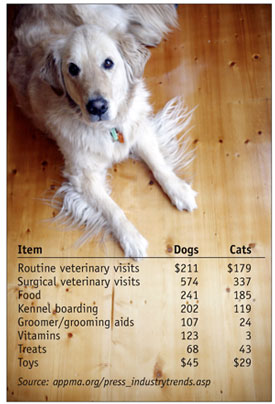 Peterson notes that, like many other services, veterinary costs are increasing. "There are more options available. In the past, if a dog or cat had a certain condition, treatment may not have been available," she says. "Also, pets are living longer because they're getting better nutrition and veterinary care, so they're getting old-age ailments we didn't see in the past." Peterson notes that, like many other services, veterinary costs are increasing. "There are more options available. In the past, if a dog or cat had a certain condition, treatment may not have been available," she says. "Also, pets are living longer because they're getting better nutrition and veterinary care, so they're getting old-age ailments we didn't see in the past."
Keeping expenses down
There are ways to minimize costs:
Choose a lower-cost pet such as a goldfish or hamster. (See ASPCA's Web site for estimated pet-care costs by species.)
Adopt from an animal shelter or rescue group (note that this may not reduce expenses over time; some rescue animals have expensive health challenges that become apparent after adoption).
Adopt a slightly older dog or cat that's already been vaccinated and spayed or neutered (although not a senior pet--pets incur more than 90% of their health-care costs in the latter half of their lives).
If you're paying to spay or neuter, look into lower-cost programs that the ASPCA or your local Humane Society offers. These organizations may offer reduced fees on other services for low-income pet owners.
Select a veterinarian before you have a medical emergency. Visit several and compare prices for annual exams and vaccinations. Ask about multipet discounts or senior pet discounts.
"Also, pets are living longer because they're getting better nutrition and veterinary care, so they're getting old-age aliments we didn't see in the past."
Keep your pet healthy by feeding it the highest-quality pet food you can afford. Limit the amount of table scraps and treats your pet eats, and make sure it gets plenty of exercise.
Don't allow dogs or cats to run free outdoors without supervision.
Give your pet the proper preventive care, including annual veterinary visits, vaccinations, and things such as ear cleaning and heartworm medication for dogs and flea and tick protection for cats and dogs.
If you suspect a health problem, call your veterinarian right away. If you wait, it might get really expensive.
Budgeting
Even if you don't indulge your pets, basic care costs can add up. That's why it's important that--before you adopt a pet--you determine whether you can afford it. "For a dog or cat, you're making a 10-, 15-, even a 20-year commitment," says Peterson.
Divide your estimated annual pet-care costs by 12, and automatically set aside that amount monthly in a credit union savings account. You'll also need to plan for medical emergencies. "I have a separate account for my pets, and every two weeks when I get paid, I put a certain amount in that account," Peterson says. "If an emergency comes up, I'll be able to afford the necessary care."
Buchwald likens pet savings accounts to saving for your child's college education. "Save while your pet is young and healthy, and you'll have the money you need when it's older and needs more care," she recommends.
You also may consider pet insurance, which works like health insurance for humans. However, according to a 2003 report by Consumer Reports, pet insurance is rarely worth the price. The costs--premiums and deductibles--are high, and most plans don't cover many common veterinary expenses, such as wellness visits. Peterson says Petplan insurance, newly available in the U.S., is an exception, providing coverage for more veterinary costs. There also are likely to be exclusions for preexisting conditions, and for conditions that are common in particular breeds.
If you choose a pet you can afford and budget appropriately for its life-time care, pet ownership can bring great rewards. After all, says Peterson, "You can't buy a better friend than a pet."
July 17, 2006
|