ApplicationsCalculatorsAbout UsRatesMembershipFAQ'sHomeEmployment
Site Search:       Thursday, February 3, 2011
Savings Accounts
Regular Share
Silver Share Certificates
Holiday Savings
ATM Card
Youth Programs
Senior Programs
Star Program
Money Savvy Articles
Retirement Articles
Account Agreement Disclosure


June Financial Fitness Challenge�Power Through Credit Card Debt

Susan Tiffany, CCUFC


As signs of progress appear in the economy, there's growing concern about a new wave of credit distress�in credit cards.

Bank stress tests released in May 2009 suggest that the 19 largest U.S. banks could see almost $82.4 billion in credit card losses by the end of 2010, if what federal regulators called an "adverse economic situation" develops.

In fact, it's often a personal adverse economic situation�demise of a car engine, emergency family trip, medical bill for a pet�that leads many consumers to use credits card even when they're not the best choice. If you have no savings cushion, using a credit card may be your only choice, and thus the debt burden grows more crushing.

It's a classic trap: You can't pay with cash because you have no savings; you can't save because you must pay off credit card debts. That may account, at least in part, for why we carry an average of 5.3 all-purpose cards these days, and the average household credit card debt is $10,679, according to industry publication The Nilson Report.

Stop digging that hole

Your first priority when credit cards have the upper hand is to stop using them. This may not be possible if you're facing an unexpected, necessary expense. But you must stop any discretionary spending on credit. You must commit to this�or admit that you're not serious about ending your dependence on credit cards.

Then turn your attention to how you will pay off the bills. Take inventory: Identify how much you owe on each card. Identify the APR (annual percentage rate) for each card. Identify the minimum monthly payment for each card. Add up all your credit card debts. Add the total minimum monthly payments.

Here's a sample of what you might collect:
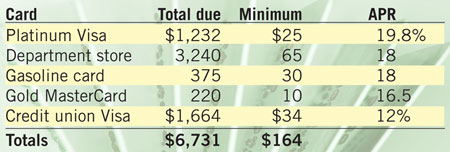
Debt Table

Next look at your spending plan and decide how much you can pay each month on all your credit cards. Let's say $300. Your next decision is how you will apply that amount to your credit card bills for the most effective payoff. There are two philosophies:

    Pay off the smaller bills first. Pay the bill with the highest APR first.
In either case, you always pay at least the minimum due�on time�on each card each month.

Choose your strategy

The rationale for paying the small bills first is to give you a sense of progress right from the get-go. In our example, you could wipe out two bills in about three months, while still keeping current on the other cards. Then you could continue paying down the balances on the three remaining bills.

The idea behind paying off cards in order of APR, high to low, is to make more progress on the debts that cost you the most. Just imagine, paying off a 20% APR credit card balance is like earning 20% on an investment�and that's a deal you won't find anywhere else these days. In this strategy, you make minimum payments on all but the bill with highest APR. You pay as much as you can on that bill from your monthly $300 credit card allotment. As you pay off each account, you continue to apply the same total each month to your cards, but transfer the largest payment to the card with the next highest APR.

Paying down a 20% APR credit card balance is like earning 20% on an investment.

You even could take a third approach and combine the two strategies. Pay off the small bills first, then tackle the remaining bills in descending APR order. This calculator can help you determine the payments you need to make to bury that credit card debt once and for all.

Financial Fitness Challenge

Credit card debt is certainly one of the prime financial fitness challenges consumers face these days. The people at your credit union can help you in this effort, in different ways.

For one, if you're carrying heavy debts, talk to someone at the credit union about getting back on track. Your credit union staff will either have a counselor you can talk to, or can refer you to someone they trust to help you and not make your situation worse.

And then, your credit union also is a safe bet to offer a better credit card, if you are eligible. In the wake of the new credit card legislation, much news coverage has noted credit union cards as exceptions to the bad actors in the market that spurred that legislation. You can count on a fair rate, low fees, and clear disclosure for a credit card from your credit union.

Please remember to register for the Financial Fitness Challenge. Each month we'll randomly select five winners to receive $50 Visa gift cards; we'll choose each month's winners only from that month's entries, so enter often.

ST
Susan Tiffany, CCUFC
[email protected]

Useful resources

Power Pay: Utah State University Extension program computes how long it will take you to get completely out of debt.

Federal Trade Commission site has information about shopping for a mortgage or auto loan, checking credit report accuracy, dealing with debt collectors, or looking for ways to protect your personal financial information.

AnnualCreditReport is the official site to help consumers obtain free credit reports.


Money Management

Articles

Economy Inspires Parting Couples to Get Creative

Financial Candor Makes Second Marriages Sweeter

December Financial Fitness Challenge�Use Simple Tools to Assess Your Finances

New Gift Card Rules Make for Happier Holidays

November Financial Fitness Challenge�Try a "Cash Only" Experiment

Help Young Adults Move Out of Your Checkbook

October Financial Fitness Challenge�Tune In to Spending Triggers

Raising Grandchildren Gives Rise to Financial Challenges

September Financial Fitness Challenge�Stay Off the Budget Trouble D List

Generations Live Together to Save Costs, Gain Quality of Life

August Financial Fitness Challenge�Three (More) Reasons to Use Direct Deposit

Preserve Your Family's Paper Trail: Replace and Safeguard Personal Records

Financing a Face-Lift May Have Wrinkles

Appliance Rebates: Save Now and Later

What Was Grandma's Password?

February Financial Fitness Challenge�Readers Share Recession Lessons

When to Wed With a Wedding Planner

January Financial Fitness Challenge�The Great Recession is a Teacher

December Financial Fitness Challenge�Get Ready to Change

Smart Spending Puts Holiday Shoppers in Control of Cart

November Financial Fitness Challenge�Be Bold, Think Small

Tough Times Series: Beating the Odds: Protect Assets From a Gambling Problem

October Financial Fitness Challenge�Money Secrets Corrode Trust in a Marriage

Debt Settlement Sets a Costly Trap

September Financial Fitness Challenge�Overdrafts Are Telling You Something

Tough Times Series: Is There a Gold Mine Hidden in Your Jewelry Box?

May Financial Fitness Challenge�Know a Windfall From a Downfall

Sounds: What You Need to Know About Digital Radio

Tough Times Series: You Can Avoid Wage Garnishment

April Financial Fitness Challenge�"Specialists" Share Financial Expertise With Spouses

March Financial Fitness Challenge—Make Room for Baby

Tough Times Series—Speaking of the Economy ... What Do You Tell Your Kids?

Loans Among Friends and Family: Win-Win, or Sure Loss?

December Challenge�Fresh Ideas From the Editors

February Challenge�Direct Deposit is a Mighty Tool

What's Your Financial Fitness Score?

Turning Points

Being a Personal Representative When a Loved One Dies

Cope Financially During a Serious Illness

Keep Your Single-Parent Family Financially Fit

Put Your Financial House in Order Before Tying the Knot

Understand All Your Options for Dealing With Debt

Make the Most of Unexpected Good Fortune

Rebuild Your Life After a Life Partner Dies

Get a Head Start With Financial Baby Talk

Calculators

Calculator: Should I Pay Off Debt or Save

Calculator: Budget Blueprint

Calculator: Keep Your Checkbook Up-to-Date

Calculator: Do I want a Fixed or Adjustable Rate Mortgage?

Calculator: What Is My Net Worth?

Calculator: What's It Worth to Cut Back My Spending

Calculator: How Does Inflation Affect Prices?

Calculator: What Will My Monthly Mortgage Payment Be?

Videos

Talk With Your Children About Family Finances

How to Balance Your Checkbook

Investing: Dollar-Cost Averaging

Debit vs. Credit

Use Direct Deposit and Automatic Transfers to Simplify Finances

Home & Family Finance Radio

Be Bold, Think Small: Small Moves That Add Up to Big Progress When Making Financial Changes

Develop a New Year's Spending Plan

Key Money Problems for College Students & Young Gen Y-ers: How Family Can Help

The "Step-Down Principle" of Reducing Expenses

Stopping Overspending

5 Holiday Shopping Tips for Tough Times

10 Ways to Save on Health Care

Is Fear Stopping You From Making Financial Decisions?

Are You Prepared to Survive a Disaster?

Stay Off the Budget Trouble D List

Groupon: What Is It And How Does It Work?

Cut Your Top Five Costs and Save Thousands (Part 1 of 2)

Cut Your Top Five Costs and Save Thousands! (Part 2 of 2)

Financial Tips for Young Adults (Part 1 of 2)

Financial Tips for Young Adults (Part 2 of 2)

Eat Locally, Save Money

Military OneSource

Keep Your Head When Facing Job Loss

Rebates: Harder to Get, Harder to Use

Build Your Emergency Savings Fund

Couples & Money: One of the Toughest Disagreements to Negotiate

Get Financially Naked: How to Talk Money With Your Honey

Where the Jobs Are Now

30-Minute Money Solutions

The Beginner's Guide to Boosting Your Financial IQ

Using Public Transit Saves Individuals $9,242 Annually

Are You Ready for Change?

Financial Resolutions for the New Decade

Red to Black College Peer-to-Peer Financial Planning Program

Free Holiday Planner Helps Budget, Track, and Adjust Spending

Financial Planning

I Will Teach You to Be Rich

Payday Lending and Usury Laws

Technology Trends at Your Credit Union

Military Financial Institutions Help Soldiers

The New GI Bill

An Insider's Guide to Spending, Saving, and Living Wisely

What to Do If You Need Financial Counseling

Go Green: Save Money, Save the Planet

Coping With Change When Your Spouse Dies

Social Cost of Financial Illiteracy

Estate Planning for Survivors

Military Couples and Personal Finance

Prenuptial Agreements

Put Low-Cost Fresh Veggies on Your Table

Home Sharing

Consumer News

Blowin' in the windfall

H&FF Radio presents investing, financial checkup tips

Find the right fitness equipment

H&FF Radio: Save on holiday shopping, gift-giving

Women and money: Ditch the jargon, chuck the charts

H&FF Radio: Holiday tips from 'Good Morning America' contributor

Fresh saving ideas as holiday season approaches

H&FF Radio: Financial topics for military servicemembers

H&FF Radio: Financial topics for military servicemembers

Survey        Privacy Policy/Disclosures        Site Map         Contact Us       Home

© 2004 HEW Federal Credit Union. All rights reserved.
HEW Federal Credit Union is federally insured by the National Credit Union Administration.

Designed & Powered by Cambium Group, LLC