AllPoint
Click Here
ApplicationsCalculatorsAbout UsRatesMembershipInsuranceFAQ'sHome
Site Search:       Friday, November 3, 2006
Savings Accounts
Regular Share
RSVIP
Holiday Savings
HEWEY Shares
CU Succeed
Silver Share Certificates
ATM Card
Star Program
Seminars
Money Savvy Articles
Retirement Articles
Account Agreement Disclosure


Following the Rules: Withdrawing From Your IRA


When you open an IRA (individual retirement account), you may think there's nothing more you need to do besides making annual contributions and accessing your money once you retire. However, if you don't plan ahead on how and when you should access your IRA money, you may get a worse tax bite than necessary.

The rules that govern minimum required distributions from IRAs are among the most complicated in our tax code. This article can only give an overview, so it's best to consult with an IRA specialist before making a distribution decision.

Required minimum distributions

If you own a traditional IRA, you must start taking out a minimum amount of money by April 1 of the year following the year in which you reach age 70�--your required beginning date. You always can take out more, but not less than, the required minimum distribution amount. The required minimum distribution amount is based on a calculation of your account's value and your life expectancy--how many more years you are expected to live (see "What's your life expectancy?"). The longer your life expectancy, the lower the annual required distribution.

If you do not take at least the minimum required withdrawal each year, you'll owe a 50% penalty on the amount that should have been withdrawn.

Roth IRA owners are not required to take minimum distributions during the owner's lifetime. Roth owners can let their IRA grow free of federal taxes longer and take the money out on their own timetable.

Tax consequences of a withdrawal

The required minimum distribution amount is based on a calculation of your account's value and your life expectancy.

Dipping into your IRA, of course, means you'll also get stuck with an income tax bill. Traditional IRA funds are taxed upon withdrawal. At that time, according to Karen Yandell Buege, IRA training manager for CUNA Mutual Group in Madison, Wis., the owner must add the amount of the withdrawal to his or her income taxes for the year of the withdrawal.

For example, if your taxable income is $30,000 and you withdraw $5,000 from your traditional IRA, then you will pay taxes on $35,000 for that year. Owners who make nondeductible contributions do not pay taxes on that portion of their traditional IRA withdrawals.

Because Roth IRA contributions are not tax deductible, they are not taxed when withdrawn. Roth IRA earnings are taxable if the withdrawal is not a qualified distribution (see sidebar: Early withdrawal penalty exceptions). Contributions to a Roth IRA are withdrawn first, so no taxes are owed until the owner "dips" into earnings.

It's the IRA owner's responsibility to determine the taxable portion of each withdrawal, according to Buege, with assistance, if needed, from a professional tax adviser.

Calculating how much to withdraw

The amount of each required minimum distribution depends on your IRA account balance at the end of the previous year divided by a joint life-expectancy figure for you, the account owner, and your account beneficiary--even if you don't have a named beneficiary (see the life expectancy table). New minimum withdrawal rules automatically assume you've designated a person 10 years your junior as your IRA beneficiary if you haven't named one.

The rules that govern minimum required distributions from IRAs are among the most complicated in our tax code.

Your minimum distribution will change every year as your account balance and your life expectancy change. So you'll need to recalculate your minimum distribution amount every year.

What's your life expectancy?
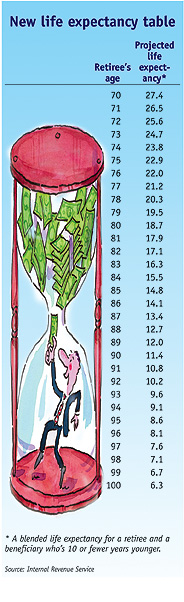
The IRS (Internal Revenue Service) calculates your life expectancy based on its own tables. There are three different tables available, but you use only one to determine your annual minimum distribution for traditional IRAs.

    The uniform lifetime distribution table--this will be used by most IRA owners generally after reaching age 70 �, according to Ed Slott, certified public accountant in Rockville Center, N.Y. The only IRA owners who will not use this table are those whose spouse is their sole beneficiary and is more than 10 years younger than the IRA owner. Beneficiaries never use this table. Joint life table--used only when the spouse is the sole beneficiary and is more than 10 years younger than the IRA owner. Beneficiaries never use this table. Single life table--used by designated beneficiaries to compute required minimum distributions on inherited retirement accounts. This table is never used to calculate lifetime required distributions.
    Roth IRA owners are not required to take minimum distributions during the owner's lifetime.

Life expectancy calculations can be complicated. Before you make any decisions, get expert advice.

New simplified rules for required minimum distributions

Tax laws generally impose a 10% federal tax penalty on the taxable portion of IRA withdrawals made before age 59�. This penalty tax is in addition to the income tax you owe on the withdrawal. There are a few exceptions to the 10% penalty, however. Early withdrawals from a traditional IRA or Roth IRA are not subject to the 10% penalty tax for:

Qualified higher education expenses for you, your spouse, your children, or your grandchildren. Qualified expenses include tuition, fees, books, supplies, and equipment. Room and board expenses also may qualify for students who attend less than half time. Qualified first-time home purchase up to $10,000. Unreimbursed medical expenses that must exceed 7.5% of your adjusted gross income for the year of the withdrawal. Medical insurance premiums for yourself, your spouse, or your dependents. Certain qualifications apply such as you lost your job or you received unemployment compensation for at least 12 consecutive weeks. If you become permanently disabled. A physician must determine that your condition is expected to be of a long, continued, and indefinite duration. Distributions to your designated beneficiary or to your estate after your death.


A Step Toward Adulthood: An After-School Job

Collaborative Divorce Softens Sting of Split

Courtesy Pay Abusers Pay the Price

Watch for Disclosure Signs at Checkout

Wealth-Building Strategies That Anyone Can Master

Financial Elderly Abuse: Do You Know the Signs?

Before You Stop Automated Payments

Budget for Your Pet's Life-Long Care

Make a Will to Have the Last Word

Take Time to Pick a Computer for College

Disaster-Proof Your Important Papers

Debit Card Debate: Check-Out Line Dilemma Reveals Real Differences

Who Pays for Hospice Care?

The Down-Payment Debate: Can You Afford No or Low Down Payments?

Grandparents Pitch in With Financial Help

Introducing the Roth 401(k)--A New Workplace Savings Opportunity

Future Grads: Consolidate Loans Before Summer

Credit/Debit Cards, Checking Accounts, Teach Teenagers to Handle Money

Pension Participants: Expand Retirement Savings for Future Security

Ten Resolutions to Trim Spending and Reduce Financial Stress

Preparation Softens Blow of Alternative Minimum Tax

A Long, Cold Winter? Simple Energy Projects Can Save You a Bundle

Health-Care Flex-Spending Accounts Get More Flexible

Protect Your Assets With a Trust Agreement

"Remarried, With Children" Brings Special Financial Challenges

Fast Fact: Advance Directive Q & A

Upping the Ante: Stakes Are High for Young Adults Playing Poker

Suddenly Solo--Life After Losing a Mate

What Bankruptcy Reform Means to You

Choose the Right Cell Phone for You

Online Banking Makes Money Management Simple and Safe

Desktop or Laptop--What's Right for You?

How to Keep Your Job When You Become Ill

Shalt Thou Buy? See If a DVR (Digital Video Recorder) Is Right for You

Back to School: Plan Your Budget

Savvy Shoppers Know "Minimum Advertised Price" Isn't Always the Bottom Line

Health Savings Accounts:
First Aid for Health-Care Bills?


Back to the 1970s? Inflation Outlook

Prenups Clarify "Yours, Mine, and Ours"

Design an IRA Strategy That's Right for You

Personal Property Appraisers Distinguish Between Trash and Treasure

Preventive Health Care: An Ounce of Prevention

Is Your TV Set to Go Digital?

Birth of a Consumer: How to Teach Your Preschooler About Money

Trusts: Securing the Financial Future for Special Needs Adults

Farmers and Consumers Connect Through Community Supported Agriculture

High Cost of Health Care Robbing Retirement

Going Solo With Health Insurance

Tax Time: Early Birds Catch a Breather

Tsunami Relief: Be an Informed Donor

Now's the Time to Max Out Flex Spending

We Love Our Debit Cards

Gift Cards Keep Giving--But Not Always to You

Type by Talking--The Scoop on Voice Recognition Software

Calculator: Budget Blueprint

Calculator: Keep Your Checkbook Up-to-Date

Calculator: Do I want a Fixed or Adjustable Rate Mortgage?

Calculator: Should I Pay Off Debt or Save

Calculator: What Is My Net Worth?

Calculator: What's It Worth to Cut Back My Spending

Calculator: How Does Inflation Affect Prices?

Calculator: What Will My Monthly Mortgage Payment Be?

Use Direct Deposit and Automatic Transfers to Simplify Finances

Making Financial Room for Baby

Teaching Young Children About Money

Staying Safe at the Cash Machine

Disaster-Proof Your Important Papers

Launch of New Home & Family Finance Radio Initiative

Tips for choosing benefits during open enrollment

Middle class families in financial bind

Preparation means peace of mind

Some habits save hundreds on energy bill

CUNA launches weekly consumer finance radio show

Weave money lessons into daily routine

September is national preparedness month

Online banking: Know the answers or get locked out

Who will manage your assets when you can't?

Use back-to-school shopping as teachable moment

Be proactive in curbing health care costs

Financial notebook provides road map, peace of mind

Tips for using plastic overseas

Sales tax holiday catches on

Consumers fork out $16 billion for extended warranties

Keep a lid on summer cooling costs

More than $60 billion just waiting to be claimed

Credit counseling--via phone or face-to-face--helps debtors

Majority of Gen X women in debt, lack investments

Keep a lid on summer energy costs

Government website offers free 'My Money' tool kit

Can't find that file? Try these simple alternatives

Using online bill-pay helps prevent ID theft

Good debt/bad debt 101

Tips for merging money with your mate

Consumer website calculates cost of payday loans

It's Financial Literacy Month: Can you pass the test?

Money and marriage: Talk to ease the tension

Five financial tips for college grads

Prepaid options critical, but costly, for unbanked consumers

Survey        Privacy Policy/Disclosures        Site Map         Contact Us       Home

© 2004 HEW Federal Credit Union. All rights reserved.
HEW Federal Credit Union is federally insured by the National Credit Union Administration.

Designed & Powered by Cambium Group, LLC