ApplicationsCalculatorsAbout UsRatesMembershipFAQ'sHomeEmployment
Site Search:       Friday, February 4, 2011
Savings Accounts
Regular Share
Silver Share Certificates
Holiday Savings
ATM Card
Youth Programs
Senior Programs
Star Program
Money Savvy Articles
Retirement Articles
Account Agreement Disclosure


Highly Educated and Deep in Debt

Amy Manzetti


Consumers accounted for 97% of all bankruptcy filings in the U.S. in 2002, according to the American Bankruptcy Institute (ABI) in Alexandria, Va. In 2001, 9% of those applying for personal bankruptcy were younger than 25, according to a Visa Corp. survey. Seven years ago, only 1% of personal bankruptcies filed were by people 25 or younger.

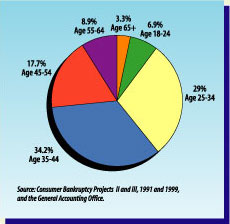
Financial experts estimate that the shaky economy could force more than 1.5 million Americans into bankruptcy this year, and about one-third of them will be in their 20s and early 30s.

Why are so many young adults filing for bankruptcy? Maybe because 30% of college graduates enter the work force saddled with $10,000 to $25,000 in credit card debt and student loans, financial experts estimate.

Almost 28% of those surveyed by Nellie Mae, a national provider of higher education loans for students and parents located in Braintree, Mass., had combined undergraduate and graduate student debt of more than $30,000. For 22% of them, loan payments ate up more than one-fifth of their monthly income.

To support postcollege debt and other expenses, college graduates need to earn more than $38,000 a year. It's estimated that new college graduates may need up to six months to find jobs in their career fields; only 51% of college students have jobs by the time they graduate.

The good news: A 30-year-old today is 50% more likely to have a bachelor's degree than his or her counterpart in 1974 and earns $5,000 more per year, adjusted for inflation. However, he or she also has more in student loans and credit card debt, is less likely to own a home, and is just as likely to be unemployed. The future of Social Security for a 30-year-old today is unknown; a 30-year-old may have to depend almost completely on his or her own savings for retirement. Experts predict that many young adults will be in the work force longer than their parents in order to save enough for their retirement. Carrying a heavy debt burden always makes saving for retirement--or any goal--that much harder.

How the trouble starts

Credit cards are a leading cause of young adults' financial troubles. Student loans usually are manageable due to their low interest rates and extended repayment terms.

College students use credit cards for a variety of reasons: dining, clothing, books, tuition, fees, and other entertainment expenses. Approximately half of colleges allow students to charge tuition and fees, as well as other services. One of five students reports using credit cards to pay for tuition and fees.

"I started college in 1992 and almost immediately I was sent credit card offers," says Dionis, of Wisconsin, a respondent to our "What's Your Story" feature. "I tell you what, I didn't turn them down. I figured that when I did graduate, I would be making $45,000 a year and paying my credit cards off would be a cinch. Boy was I wrong. By the time I graduated college, I had almost $15,000 in credit card debt, and I was barely keeping up with the minimum payment amounts."

(We developed this article with input from readers contributing to What's Your Story.)

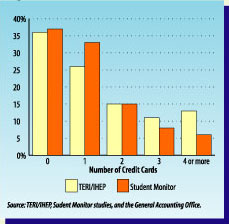
More than 80% of college students have at least one credit card by the end of their freshman year, according to Robert Manning, author of "Credit Card Nation: The Consequences of America's Addiction to Credit" (ISBN 0465043674). Of those, 25% received their first card in high school. Nellie Mae found that the percentage of college students with four or more credit cards hit 32% in 2000 and continues to rise.

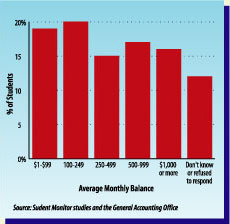
A Consumer Federation of America (CFA), Washington, D.C., survey says undergraduate students carry an average $2,000 balance, and one-fifth of students carry balances of more than $10,000. The CFA report indicates that many students are refinancing their debt either through student loans or with private debt consolidation.

Jennifer, of Georgia, got her first credit card when she was 18. "After that first card, I started getting preapproval offers from every credit card company imaginable. By the time I was 22, I was $5,000 in credit card debt."

Credit card issuers market to college students because they view them as good, new customers--although many college students have little to no income while in college.

Many universities allow credit card companies to solicit on campus grounds, considered by some to be part of the problem. Some alumni associations, athletic departments, and/or bookstores have relationships with credit card issuers, too, that allow issuers to solicit students.

More than 80% of college students have at least one credit card by the end of their freshman year.
Lack of financial education also is a problem contributing to young adults' financial troubles. The Jump$tart Coalition for Personal Financial Literacy's 2002 survey revealed high-school seniors are ignorant about personal finances. Overall, participants in the survey answered only 50.2% of the questions correctly. Jump$tart is a nonprofit provider of personal financial education programs based in Washington, D.C.

While it's easy to blame someone else, young adults can't ignore their own responsibility to educate themselves about managing credit. More than half of teens surveyed by the National Consumers League in Washington, D.C., mistakenly said that a credit card represents only an informal agreement to repay the debt.

Many credit card issuers provide consumer education on their Web sites, and the people at your credit union will be able to provide answers to your credit card questions. Also, some universities offer personal financial education during freshman orientation.

Suffering the consequences

The convenience of credit cards may tempt students to live beyond their means. Excessive credit card debt and late payments can impair a cardholder's credit rating and make it more difficult and costly to obtain credit in the future.

Students with high consumer debt are more likely to earn poorer grades, drop out of school, suffer from depression, file for bankruptcy, and work more hours to pay their bills. Credit card debt also has been linked to a number of suicides by college students, according to The Journal of Consumer Affairs, Auburn University, Ala.

Filing for bankruptcy often is seen as a way out of debt trouble to young people. However, many people who declare bankruptcy end up wishing they hadn't. They find out the hard way that:

    More than 1.5 million Americans may declare bankruptcy this year; about one-third of them will be in their 20s and early 30s.
    Bankruptcy mars your credit record. It stays on your credit report for 10 years. You'll have a tougher time qualifying for future credit, such as an auto loan or a home mortgage. All your financial obligations don't vanish with bankruptcy. You'll still owe alimony, child support, most taxes, and student loans. Bankruptcy even might prevent you from getting a job, as employers sometimes check potential employees' credit reports.

Thirty percent of college graduates enter the work force with $10,000 to $25,000 in credit card debt and student loans.
A national credit-counseling expert says consumers pay more--a lot more--for credit after filing bankruptcy. Steve Rhode, president and founder of Myvesta.org, says families with clean credit pay an average of $1,100 each month for mortgage and auto loans. Because of higher interest rates, a postbankruptcy family pays almost $1,900 for the same items.

Chad, from Georgia, says he and his wife had to file for Chapter 13 bankruptcy--where the debtor repays some or all debt under a repayment plan--because they got into the "credit card craze" and accumulated up to $50,000 in debt. "Bankruptcy is a way out, but it's a very hard way. We know it's going to be very hard to rebuild from this, but we learned the lesson of money management the hard way," says Chad.

Credit counseling

If you're struggling to keep up with the minimum payments on your credit cards, you could benefit from credit counseling.

The Consumer Credit Counseling Service (CCCS) provides free and confidential consultations with professional budget counselors trained and certified by the National Foundation for Credit Counseling (NFCC), Silver Spring, Md. If needed, CCCS can arrange debt repayment plans between consumers and creditors, sometimes negotiating for lower fees or reduced penalties on delinquent bills. CCCS offices generally charge around $15 a month to manage debt repayment plans.

To find the nearest CCCS office, call 800-388-2227, or visit www.nfcc.org.

Watch out for some firms running credit-counseling commercials on TV nationwide. The majority of the new firms advertising on TV charge fees and get bonuses from credit card issuers for every name they sign up, according to the South Florida Sun-Sentinel, Fort Lauderdale, Fla.

Some are legally structured as nonprofits but funnel large amounts of money to their own executives in the form of pay, bonuses, and real-estate deals.

A good credit-counseling service will be partially supported by grants and charitable donations, and not depend on debtor's fees for any more than 60% to 80% of its income. It will cap fees at $25 a month or less. It also will offer free counseling and may have as many as 50% of its clients in counseling alone--not enrolled in a debt repayment plan.

Be sure to also ask someone at your credit union for referral to a local, reputable credit-counseling agency.

Also be leery of and thoroughly investigate companies that say they will help you out of debt by consolidating your debt load. "When I couldn't afford the minimum monthly payments for the nine credit card accounts I accumulated, I turned to one of those consolidation companies," Dionis says. "This was the mistake that really got me in trouble with my credit. I chose the first place that promised to clean up my credit and get me back on track. It was an out-of-state place I found on the Internet." It turns out, "They [the Internet consolidation company] were making my payments to my creditors late and ruining my credit further than it already was."

Prevent drowning in debt

Order a copy of your credit report from all three credit-reporting agencies once a year. Keep track of, and closely monitor all of your student loans. Be aware of repayment terms. Instead of a credit card, use a debit card where the money is withdrawn directly from your share draft/checking account. Unlike a credit card, there's no outstanding balance or interest to pay. Credit cards are helpful in emergencies or if you usually are able to pay off the balance each month. Credit unions typically offer lower interest rates on credit cards than other financial institutions--ask someone at your credit union for more information. Create a budget and stick to it. Be aware of your debt-to-income ratio. Use our calculator to determine your debt-to-income ratio. Stay current on payments--a late payment on one account actually could cost you higher rates and fees on all your accounts; other creditors monitor your credit habits and price credit accordingly. Or contact your creditor to see if it's willing to work out a reduced payment plan if you're unable to keep up with payments.

Proportion of Debtors Filing For Bankruptcy by Age Group

Number of Credit Cards in Students' Names

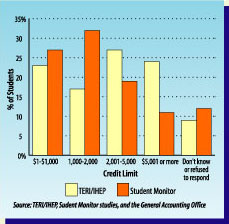
Credit Limits on College Students' Cards

Average Monthly Balances on Student Credit Cards for Students Who Carry a Balance


Money Management

Articles

Economy Inspires Parting Couples to Get Creative

Financial Candor Makes Second Marriages Sweeter

December Financial Fitness Challenge�Use Simple Tools to Assess Your Finances

New Gift Card Rules Make for Happier Holidays

November Financial Fitness Challenge�Try a "Cash Only" Experiment

Help Young Adults Move Out of Your Checkbook

October Financial Fitness Challenge�Tune In to Spending Triggers

Raising Grandchildren Gives Rise to Financial Challenges

September Financial Fitness Challenge�Stay Off the Budget Trouble D List

Generations Live Together to Save Costs, Gain Quality of Life

August Financial Fitness Challenge�Three (More) Reasons to Use Direct Deposit

Preserve Your Family's Paper Trail: Replace and Safeguard Personal Records

Financing a Face-Lift May Have Wrinkles

Appliance Rebates: Save Now and Later

What Was Grandma's Password?

February Financial Fitness Challenge�Readers Share Recession Lessons

When to Wed With a Wedding Planner

January Financial Fitness Challenge�The Great Recession is a Teacher

December Financial Fitness Challenge�Get Ready to Change

Smart Spending Puts Holiday Shoppers in Control of Cart

November Financial Fitness Challenge�Be Bold, Think Small

Tough Times Series: Beating the Odds: Protect Assets From a Gambling Problem

October Financial Fitness Challenge�Money Secrets Corrode Trust in a Marriage

Debt Settlement Sets a Costly Trap

September Financial Fitness Challenge�Overdrafts Are Telling You Something

Tough Times Series: Is There a Gold Mine Hidden in Your Jewelry Box?

May Financial Fitness Challenge�Know a Windfall From a Downfall

Sounds: What You Need to Know About Digital Radio

Tough Times Series: You Can Avoid Wage Garnishment

April Financial Fitness Challenge�"Specialists" Share Financial Expertise With Spouses

March Financial Fitness Challenge—Make Room for Baby

Tough Times Series—Speaking of the Economy ... What Do You Tell Your Kids?

Loans Among Friends and Family: Win-Win, or Sure Loss?

December Challenge�Fresh Ideas From the Editors

February Challenge�Direct Deposit is a Mighty Tool

What's Your Financial Fitness Score?

Turning Points

Being a Personal Representative When a Loved One Dies

Cope Financially During a Serious Illness

Keep Your Single-Parent Family Financially Fit

Put Your Financial House in Order Before Tying the Knot

Understand All Your Options for Dealing With Debt

Make the Most of Unexpected Good Fortune

Rebuild Your Life After a Life Partner Dies

Get a Head Start With Financial Baby Talk

Calculators

Calculator: Should I Pay Off Debt or Save

Calculator: Budget Blueprint

Calculator: Keep Your Checkbook Up-to-Date

Calculator: Do I want a Fixed or Adjustable Rate Mortgage?

Calculator: What Is My Net Worth?

Calculator: What's It Worth to Cut Back My Spending

Calculator: How Does Inflation Affect Prices?

Calculator: What Will My Monthly Mortgage Payment Be?

Videos

Talk With Your Children About Family Finances

How to Balance Your Checkbook

Investing: Dollar-Cost Averaging

Debit vs. Credit

Use Direct Deposit and Automatic Transfers to Simplify Finances

Home & Family Finance Radio

Be Bold, Think Small: Small Moves That Add Up to Big Progress When Making Financial Changes

Develop a New Year's Spending Plan

Key Money Problems for College Students & Young Gen Y-ers: How Family Can Help

The "Step-Down Principle" of Reducing Expenses

Stopping Overspending

5 Holiday Shopping Tips for Tough Times

10 Ways to Save on Health Care

Is Fear Stopping You From Making Financial Decisions?

Are You Prepared to Survive a Disaster?

Stay Off the Budget Trouble D List

Groupon: What Is It And How Does It Work?

Cut Your Top Five Costs and Save Thousands (Part 1 of 2)

Cut Your Top Five Costs and Save Thousands! (Part 2 of 2)

Financial Tips for Young Adults (Part 1 of 2)

Financial Tips for Young Adults (Part 2 of 2)

Eat Locally, Save Money

Military OneSource

Keep Your Head When Facing Job Loss

Rebates: Harder to Get, Harder to Use

Build Your Emergency Savings Fund

Couples & Money: One of the Toughest Disagreements to Negotiate

Get Financially Naked: How to Talk Money With Your Honey

Where the Jobs Are Now

30-Minute Money Solutions

The Beginner's Guide to Boosting Your Financial IQ

Using Public Transit Saves Individuals $9,242 Annually

Are You Ready for Change?

Financial Resolutions for the New Decade

Red to Black College Peer-to-Peer Financial Planning Program

Free Holiday Planner Helps Budget, Track, and Adjust Spending

Financial Planning

I Will Teach You to Be Rich

Payday Lending and Usury Laws

Technology Trends at Your Credit Union

Military Financial Institutions Help Soldiers

The New GI Bill

An Insider's Guide to Spending, Saving, and Living Wisely

What to Do If You Need Financial Counseling

Go Green: Save Money, Save the Planet

Coping With Change When Your Spouse Dies

Social Cost of Financial Illiteracy

Estate Planning for Survivors

Military Couples and Personal Finance

Prenuptial Agreements

Put Low-Cost Fresh Veggies on Your Table

Home Sharing

Consumer News

Blowin' in the windfall

H&FF Radio presents investing, financial checkup tips

Find the right fitness equipment

H&FF Radio: Save on holiday shopping, gift-giving

Women and money: Ditch the jargon, chuck the charts

H&FF Radio: Holiday tips from 'Good Morning America' contributor

Fresh saving ideas as holiday season approaches

H&FF Radio: Financial topics for military servicemembers

H&FF Radio: Financial topics for military servicemembers

Survey        Privacy Policy/Disclosures        Site Map         Contact Us       Home

© 2004 HEW Federal Credit Union. All rights reserved.
HEW Federal Credit Union is federally insured by the National Credit Union Administration.

Designed & Powered by Cambium Group, LLC